- Home
- About Us
- EMR Features
-
-
- EMR Features
-
- Patient Health Features
-
- Clinic Features
-
-
- Specialties
-
- Blog
- Contact Us
Managing patient information is one of the most important parts of running a modern clinic. Yet when forms, patient records, and clinical documentation are handled through disconnected or paper-based processes, even simple tasks can become time-consuming.
A clinical management software can help Ontario clinics digitize these processes, making it easier to capture, organize, and access patient information throughout the care journey.
For clinics evaluating EMR Ontario solutions, the ability to connect patient data, documentation, forms, scheduling, referrals, and other clinical workflows is increasingly important.
Modern EMR systems in Ontario are expected to do more than simply store electronic patient records. Clinics need technology that can support the wider workflow surrounding each patient encounter.
A modern EMR in Ontario can connect activities such as:
This is where medical EMR systems and clinical management software increasingly overlap. Rather than managing each process through separate tools, clinics can use an integrated platform to keep information connected throughout the patient journey.
Paper forms can create additional administrative work for clinics. Printing, completing, scanning, filing, and locating documents can take valuable staff time.
Digital forms provide a more efficient way to capture and organize information.
With forms digitization, clinics can:
For clinics looking to modernize their operations, digital forms can become an important part of a broader clinical management software strategy.
Digitizing a form is only part of the solution. The greater benefit comes when information collected through a form can become part of the patient’s digital record.
For example:
Patient completes form
↓
Information is captured digitally
↓
Data is associated with the patient record
↓
Provider reviews information
↓
Clinical documentation is updated
↓
Information remains available for future visits
This connected approach can reduce the need to manage patient information across separate paper and digital systems.
Different appointments and clinical situations require different types of documentation.
Customizable templates can help providers structure information according to their practice and specialty.
Templates can support:
Instead of starting documentation from scratch, providers can use structured templates while still maintaining flexibility for individual patient needs.
A medical EMR system provides the foundation for storing and accessing patient information, while clinical management software extends that foundation into the everyday workflows of a clinic.
For example, information collected through a digital form can become part of the patient’s record and then be available to the provider during a consultation. That same record can support documentation, prescriptions, referrals, billing, and future follow-up.
For clinics comparing EMR systems in Ontario, this level of integration is important because the value of an EMR isn’t only in storing information—it’s in making that information useful throughout the clinical workflow.
Artificial intelligence is becoming an increasingly important part of healthcare technology.
AI-supported documentation can help reduce some of the repetitive work involved in organizing clinical information. Combined with structured templates and digital patient records, AI can support more efficient documentation workflows.
The goal is not to replace clinical decision-making. Instead, AI can help reduce administrative tasks so providers can focus more of their attention on patient care.
Patient data doesn’t exist in isolation.
A single patient may interact with multiple parts of a clinic’s workflow:
Scheduling → Patient Records → Documentation → Labs → Prescriptions → Referrals → Billing → Follow-Up
When these processes are disconnected, information may need to be entered or transferred multiple times.
A connected clinical management software platform can help bring these workflows together, giving providers and staff a more complete view of the patient journey.
When evaluating EMR Ontario solutions, clinics should look beyond individual features and consider how well the system connects their day-to-day workflows.
Important questions include:
The right EMR in Ontario should help connect clinical and administrative processes rather than add another disconnected system to the clinic.
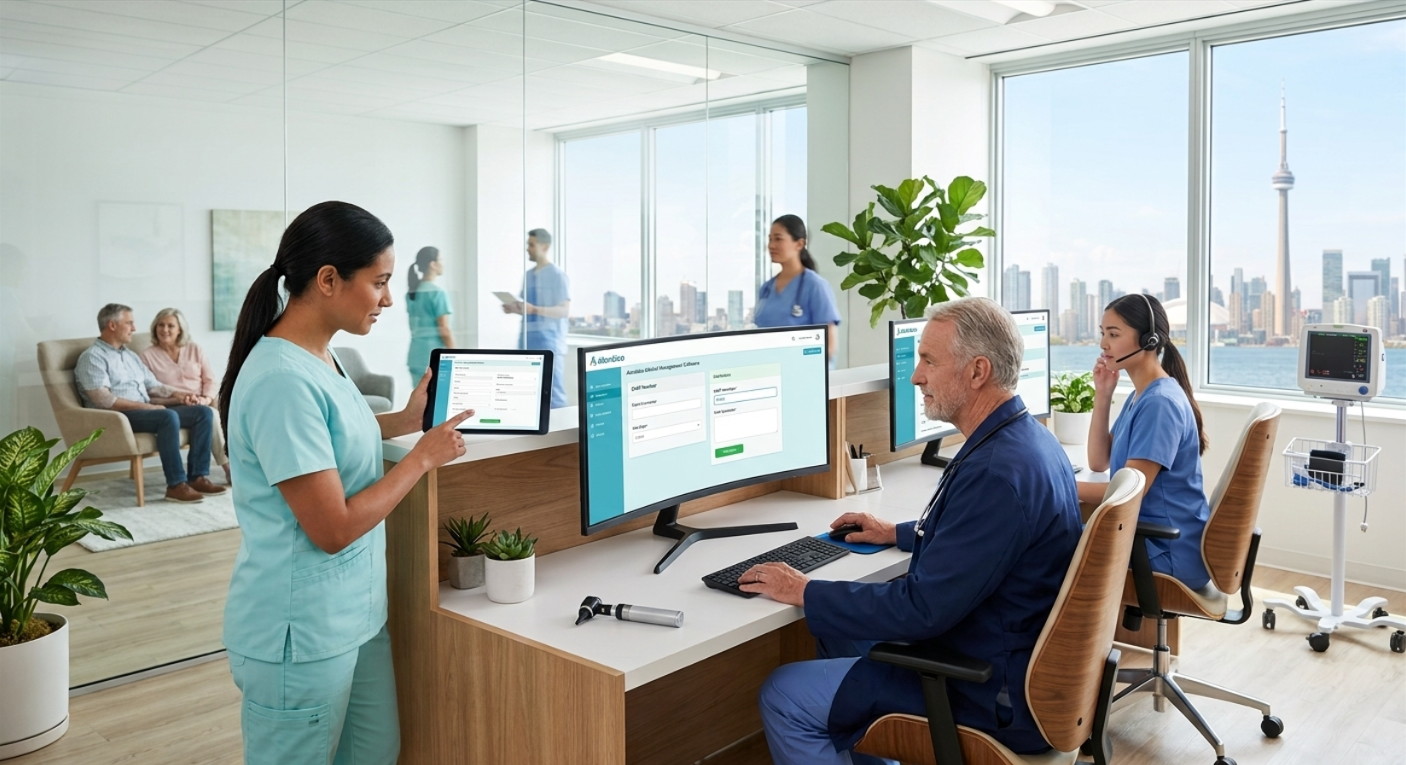
Alembico EMR brings patient records, digital forms, templates, clinical documentation, scheduling, referrals, prescriptions, labs, billing, messaging, and reporting together within one cloud-based platform.
With Forms Digitization, Templates, and AI-based Documentation Cataloging, Alembico is designed to help Ontario clinics move from fragmented information management toward more connected digital workflows.
As an OntarioMD Certified EMR, Alembico provides a modern medical EMR system designed around the needs of Ontario healthcare providers.
For clinics evaluating EMR systems in Ontario, Alembico combines core EMR capabilities with clinical and administrative workflows in one platform.
Tags: Clinic appointment scheduling software, Clinic Management Software, Clinic Management System, EMR software, EMR Software in Ontario